
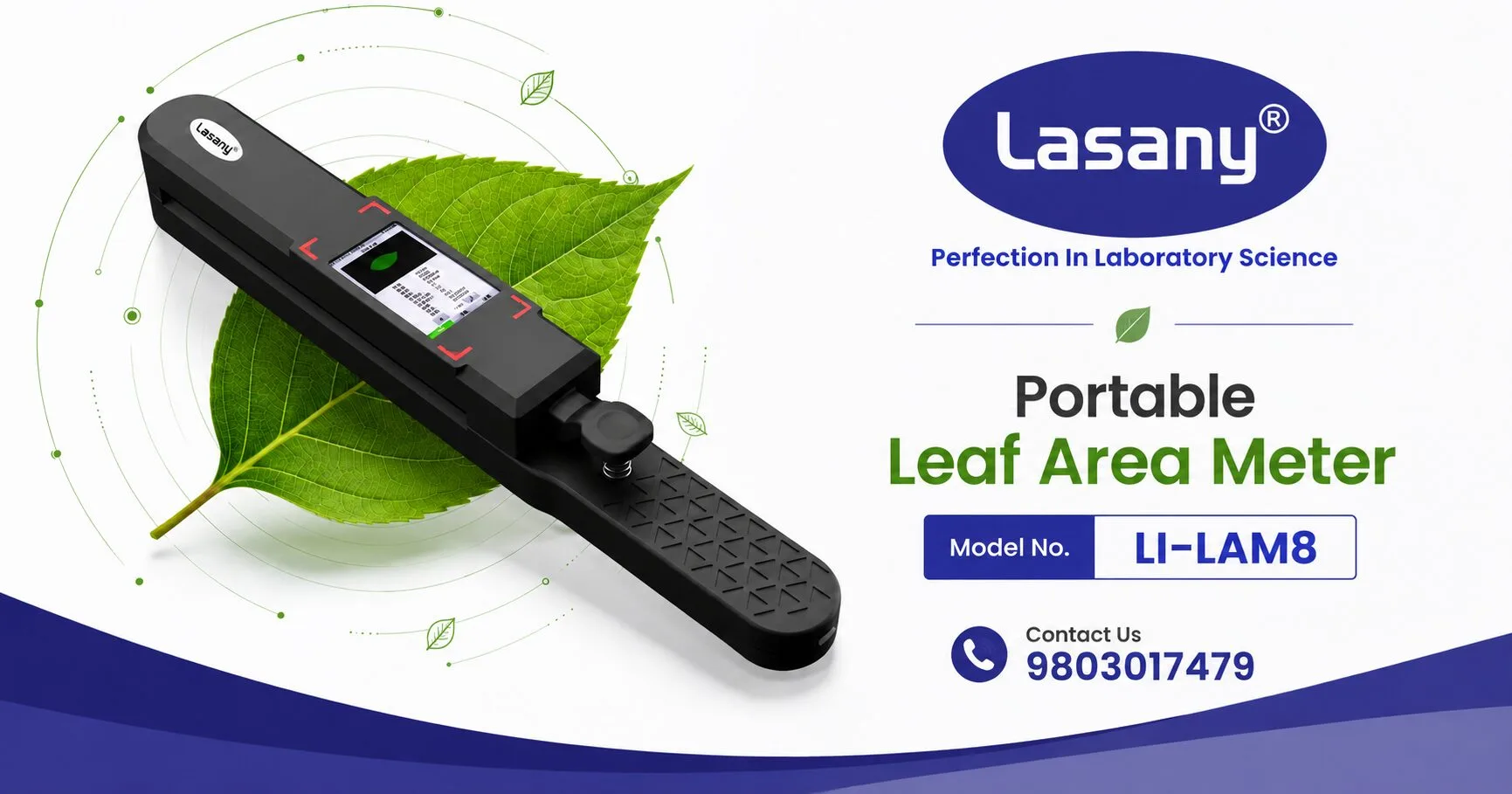
Portable Leaf Area Meter Price in India : Complete Buyer’s Guide for Agricultural & Research Laboratories
In modern plant science, agriculture, and environmental research, leaf area is one of the most important physiological parameters scientists and agronomists measure. It directly influences photosynthesis rates, water transpiration, canopy light interception, and overall crop productivity. Accurately measuring this parameter — quickly, reliably, and affordably — is what makes the Portable Leaf Area Meter an indispensable tool in field and laboratory settings worldwide.
Whether you are a crop scientist studying the effects of fertilizer on leaf development, an agronomist monitoring canopy health across a large farm, or a plant physiologist conducting photosynthesis research, the right Portable Leaf Area Meter transforms a time-consuming, labour-intensive process into a rapid, highly accurate, digital workflow.
In this comprehensive guide, Lasany International — one of India’s most trusted manufacturers and suppliers of scientific, agricultural, and analytical instruments — walks you through everything you need to know about the Portable Leaf Area Meter: how it works, its key features, applications across disciplines, and — importantly — the Portable Leaf Area Meter Price in India and what factors influence the cost of these precision instruments.
What Is a Portable Leaf Area Meter?
A Portable Leaf Area Meter is a handheld, field-deployable scientific instrument designed to measure the surface area of plant leaves quickly, accurately, and non-destructively. It uses advanced optical or imaging technology to scan a leaf and calculate its total two-dimensional surface area in cm² or mm² — a measurement that is fundamental to understanding plant growth, health, and productivity.
Unlike traditional destructive leaf area measurement methods — such as grid counting or planimeters that require detaching leaves and tracing them on paper — a modern Portable Leaf Area Meter provides instant, digital measurements that preserve the integrity of the plant sample. This non-destructive capability makes the instrument ideal for longitudinal studies where the same leaves must be measured repeatedly over time.
The Portable Leaf Area Meter Price in India ranges widely depending on the model, measurement technology, and features offered — from basic handheld scanners for simple field use to advanced imaging-based systems with data storage, USB connectivity, and PC software. Understanding what drives Portable Leaf Area Meter Price variations helps buyers make smarter, more value-aligned purchasing decisions.
How Does a Portable Leaf Area Meter Work?
The working principle of the Portable Leaf Area Meter depends on its measurement technology. The most widely used approach is the laser scanning or optical imaging method:
- Step 1 — Leaf Insertion: The leaf (or a portion of the leaf) is placed into the measurement chamber of the Portable Leaf Area Meter — either by feeding it through a scanning slot or placing it flat on an optical sensor.
- Step 2 — Optical Scanning: An internal light source (LED or laser) illuminates the leaf from above or below while an optical sensor or CCD array captures the silhouette or image of the leaf profile.
- Step 3 — Image Processing: The embedded microprocessor of the Portable Leaf Area Meter applies image analysis algorithms to calculate the total surface area of the leaf based on the number of pixels or scanned units that correspond to leaf material versus empty space.
- Step 4 — Instant Display: The calculated leaf area is displayed instantly on the instrument’s LCD or digital screen in real time — typically in cm² or mm² — along with additional parameters such as length and width in more advanced models.
- Step 5 — Data Storage and Transfer: Most modern Portable Leaf Area Meters include built-in data storage that logs individual measurements for later retrieval. Data is typically transferred to a computer via USB for further analysis, statistical processing, and reporting.
Key Features to Look for in a Portable Leaf Area Meter
When evaluating any Portable Leaf Area Meter Price option, these are the critical performance and usability features to assess — understanding these helps justify the Portable Leaf Area Meter Price you invest in:
- Measurement Accuracy — The most important specification. A high-quality Portable Leaf Area Meter should offer accuracy within ±2% to ±3% of actual leaf area — sufficient for both research and agricultural field applications.
- Measurement Range — The maximum leaf size the instrument can accommodate. Research-grade Portable Leaf Area Meters typically measure leaf areas up to 2000 × 155 mm² per pass, with multi-pass capability for larger leaves.
- Non-Destructive Measurement — Essential for longitudinal plant studies. A good Portable Leaf Area Meter should measure without cutting, pressing, or otherwise altering the leaf structure.
- Rapid Measurement Speed — Field work demands speed. Look for instruments that deliver a measurement within seconds to support high-throughput data collection across hundreds of plants per session.
- Data Storage Capacity — Models with built-in memory or SD card support allow researchers to store hundreds to thousands of measurements per field session without needing a laptop in the field.
- Portability and Battery Life — A true Portable Leaf Area Meter Price investment pays off when the instrument is genuinely field-ready — lightweight, ergonomic, and battery-powered for extended use without mains access.
- PC Connectivity and Software — USB or Bluetooth connectivity, combined with data analysis software, turns the Portable Leaf Area Meter into a powerful research tool capable of generating statistical summaries, growth curves, and comparative reports.
- Durability — Field instruments face dust, moisture, and physical handling. A well-built Portable Leaf Area Meter should be robust enough for regular outdoor use across diverse agricultural and environmental research environments.
Applications of the Portable Leaf Area Meter
The Portable Leaf Area Meter Price you invest in is well justified across a remarkable breadth of scientific and agricultural disciplines where this instrument finds application:
- Agricultural Research and Crop Science
The Portable Leaf Area Meter is essential for measuring leaf area index (LAI) — the ratio of total one-sided leaf area per unit of ground surface area — a key predictor of crop photosynthesis capacity, canopy light interception, and yield potential. Agronomists use it to study how different crop varieties, fertilizer treatments, irrigation regimes, and soil types affect leaf growth and canopy development.
- Plant Physiology and Photosynthesis Research
Leaf area is a fundamental variable in calculating photosynthesis rates, stomatal conductance, and transpiration per unit area. Researchers in plant physiology use the Portable Leaf Area Meter to obtain precise leaf area data that feeds into calculations of net CO₂ assimilation, water use efficiency, and primary productivity models.
- Horticulture and Fruit Crop Management
Horticulturists and orchard managers use the Portable Leaf Area Meter to monitor leaf development in fruit trees, grapevines, and vegetable crops — enabling data-driven decisions on canopy management, pruning, and nutrient application timing.
- Forestry and Environmental Science
Forest ecologists use the Portable Leaf Area Meter to measure leaf area in tree species across different canopy layers, supporting studies on forest biomass estimation, carbon sequestration capacity, and ecosystem productivity modeling.
- Stress Response and Plant Pathology Studies
The Portable Leaf Area Meter allows plant pathologists and stress physiologists to quantify the impact of diseases, pest damage, drought, salinity, and heavy metal toxicity on leaf area reduction — providing an objective, quantitative measure of plant stress severity.
- Seed and Breeding Research
Plant breeders use the Portable Leaf Area Meter Price-competitive LI-LAM8 to compare leaf morphology traits across germplasm collections and breeding lines — supporting the selection of varieties with optimal leaf architecture for target production environments.
Portable Leaf Area Meter Price in India: What to Expect
Understanding Portable Leaf Area Meter Price in India helps laboratories and agricultural organizations make informed procurement decisions. The Portable Leaf Area Meter Price in the Indian market varies based on several key factors:
- Technology Type : Basic optical scanner models are more affordable, while advanced imaging-based instruments with higher resolution, larger measurement ranges, and integrated software command higher Portable Leaf Area Meter Prices. The technology level is the single biggest driver of Portable Leaf Area Meter Price variation across brands.
- Brand and Origin: Indian-manufactured instruments from trusted brands like Lasany International offer the best Portable Leaf Area Meter Price advantage — delivering internationally comparable performance at a fraction of the cost of imported equivalents.
- Features and Specifications: Instruments with data storage, PC connectivity, multi-parameter measurement (leaf area + length + width + perimeter), and field-durable enclosures command higher Portable Leaf Area Meter Prices than basic single-function models.
- After-Sales Support: Instruments backed by local service networks, calibration support, and comprehensive warranties represent better long-term value — even at a slightly higher initial Portable Leaf Area Meter Price.
For researchers and institutions seeking a transparent, competitive Portable Leaf Area Meter Price from a trusted Indian manufacturer, Lasany International’s LI-LAM8 model is among the most value-aligned options available in the Indian market today.
Lasany International: India’s Trusted Portable Leaf Area Meter Manufacturer
When sourcing a high-performance Portable Leaf Area Meter in India, Lasany International is the name agricultural scientists, researchers, and educational institutions consistently trust. Established in 1998 and headquartered at SCF-132, Sector 17, Panchkula, Haryana, Lasany International has built a decades-long reputation for manufacturing precision laboratory, scientific, and agricultural instruments that meet the needs of researchers and professionals across India and more than 90 countries worldwide.
Lasany International LI-LAM8 Portable Leaf Area Meter
The PORTABLE LEAF AREA METER Model LI-LAM8 by Lasany International is a high-precision, handheld instrument designed for accurate measurement and analysis of leaf area in plants — equally suitable for laboratory environments and demanding field conditions.
Key Features of the LI-LAM8:
- Advanced Optical Technology — Equipped with precision optical sensors that deliver accurate leaf area measurements for a wide range of plant species, from small grass blades to large broadleaf crops.
- User-Friendly Interface — An intuitive digital display clearly presents measurement results, settings, and operational parameters — enabling operators to work efficiently without extensive training.
- Rapid Measurement — The LI-LAM8 delivers quick, real-time measurements that are essential when processing large numbers of leaf samples in time-sensitive field or glasshouse experiments.
- Built-In Data Storage — Internal memory logs individual measurement records for retrieval, review, and export — eliminating the need for manual data recording in the field.
- High Repeatability — Consistent measurement results across repeated trials on the same leaf sample confirm the LI-LAM8’s suitability for rigorous scientific research and quality-controlled agricultural monitoring.
- Portable Field Design — Lightweight, compact, and battery-powered — the LI-LAM8 Portable Leaf Area Meter is designed to be carried comfortably to field locations, greenhouses, and research plots without fatigue.
- Versatile Application — Suitable for agricultural research, plant physiology studies, crop science, environmental monitoring, university research, and government laboratory applications.
Why Researchers and Agronomists Choose Lasany International
- Competitive Portable Leaf Area Meter Price — Lasany International offers the LI-LAM8 at a Portable Leaf Area Meter Price that delivers exceptional value relative to its measurement capabilities — making high-precision leaf area analysis accessible to Indian research institutions, agricultural universities, and government departments without requiring the budget of imported alternatives.
- Trusted Manufacturing Pedigree — With over 25 years of instrument manufacturing experience and a product portfolio spanning spectrophotometers, viscometers, soil testing instruments, chlorophyll meters, and agricultural measurement instruments, Lasany International brings deep instrumentation expertise to every product it manufactures.
- Pan-India Service Network — Every LI-LAM8 Portable Leaf Area Meter purchase is backed by Lasany International’s nationwide service support — including installation guidance, operator training, calibration assistance, and responsive technical support — ensuring laboratories and field teams get reliable, uninterrupted performance from their instrument.
- Global Export Confidence — Lasany International exports its instruments to customers across Vietnam, Indonesia, Turkey, Brazil, Zimbabwe, Sri Lanka, Iran, Ghana, Nigeria, Uganda, Israel, Kenya, and many more international markets — reflecting the quality and reliability that global agricultural research institutions expect.
Best Practices for Using a Portable Leaf Area Meter
Getting accurate, consistent results from your Portable Leaf Area Meter — and maximising the return on your Portable Leaf Area Meter Price investment — requires following sound operating protocols:
- Clean Leaves Before Measurement — Remove soil, dust, water droplets, and debris from leaf surfaces before scanning. Any contamination on the leaf surface can affect the optical sensor reading and introduce measurement error.
- Keep the Instrument Clean — Regularly clean the optical scanning chamber and sensor window with a soft, dry cloth to prevent dust accumulation that could affect accuracy.
- Calibrate Regularly — Follow the manufacturer’s calibration schedule to ensure the Portable Leaf Area Meter Price investment continues to yield accurate measurements throughout its operational life.
- Measure at Consistent Leaf Orientation — For maximum repeatability, always insert leaves at the same orientation and feeding speed through the measurement slot of the Portable Leaf Area Meter.
- Record Environmental Conditions — Note temperature, humidity, and time of measurement during field sessions, as extreme conditions can affect both the plant and instrument performance.
- Charge or Replace Batteries Before Field Work — Always start a field session with fully charged batteries to avoid data loss or incomplete measurement sessions.
Conclusion: Invest in the Right Portable Leaf Area Meter at the Right Price
The Portable Leaf Area Meter has transformed leaf area measurement from a slow, manual process into a fast, precise, and data-rich scientific workflow that empowers researchers, agronomists, and plant breeders to make better, evidence-based decisions about crop management and plant science.
For Indian laboratories, universities, agricultural research stations, and government institutes seeking a dependable, high-precision Portable Leaf Area Meter at a competitive Portable Leaf Area Meter Price, Lasany International’s LI-LAM8 delivers everything you need — advanced optical measurement, intuitive operation, field-ready portability, built-in data storage, and the after-sales confidence of one of India’s most respected scientific instrument manufacturers.
Invest in the precision your plant research demands. Choose the Portable Leaf Area Meter from Lasany International at a Portable Leaf Area Meter Price that works for your budget — and experience the difference that genuine instrumentation expertise makes in the field and laboratory.
Get in Touch with Us: –
Panchkula, Haryana
Website: https://lasany.org/
Address: SCF-132, Sector 17, Panchkula, Haryana 134109
Email:- lasanyinternationalindia@gmail.com, sales@lasany.org
Online Support:- 9888911439 / 9803017479
If you are looking for laboratory, analytical, and medical products, then Lasany International is the perfect choice for you