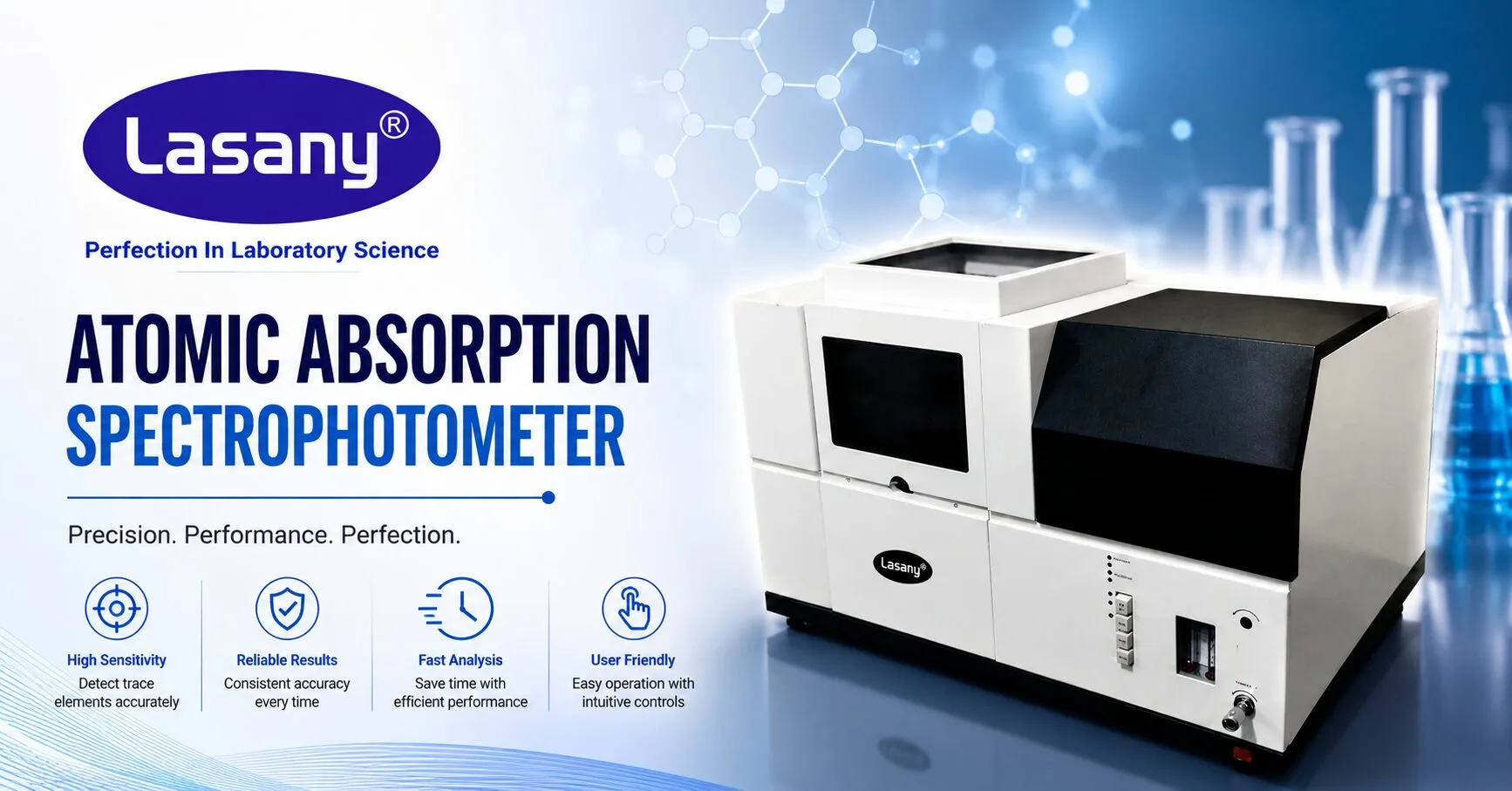
In the world of analytical chemistry, detecting trace elements at concentrations measured in parts per million (ppm) or even parts per billion (ppb) requires instruments of extraordinary sensitivity and precision. The Atomic Absorption Spectrophotometer is exactly the instrument that has been trusted by laboratories worldwide for decades and remains one of the most powerful and reliable tools available for quantitative elemental analysis.
Whether you are testing drinking water for heavy metal contamination, verifying the purity of a pharmaceutical raw material, analyzing soil samples for agricultural assessment, or monitoring industrial effluents for regulatory compliance, it delivers the sensitivity, accuracy, and reproducibility that modern science demands.
In this comprehensive guide, Lasany International—one of India’s most respected manufacturers of scientific, laboratory, and analytical instruments—walks you through everything essential about the atomic absorption spectrophotometer: its working principle, core components, industry applications, technical capabilities, and how to choose the right system for your laboratory’s needs.
What Is an Atomic Absorption Spectrophotometer?
An Atomic Absorption Spectrophotometer is a precision analytical instrument used to determine the concentration of specific metallic elements in liquid, solid, or gaseous samples. It operates on the fundamental principle that free atoms in the ground state absorb light at wavelengths characteristic to each element—and the amount of light absorbed is directly proportional to the concentration of that element in the sample.
This is capable of detecting and quantifying over 70 metallic and semi-metallic elements, including lead, cadmium, copper, zinc, iron, chromium, arsenic, mercury, calcium, magnesium, sodium, potassium, and many more—each at trace-level concentrations that no other routine analytical technique can match in simplicity and cost-effectiveness.
Unlike UV-Vis spectrophotometry, which measures molecular absorbance, the atomic absorption spectrometer targets individual atomic species—giving it the elemental specificity and detection sensitivity that make it indispensable in environmental, clinical, pharmaceutical, and industrial laboratories globally.
Working Principle of the Atomic Absorption Spectrophotometer
The working principle of the atomic absorption spectrophotometer is based on the Beer-Lambert Law applied at the atomic level. Here is how it works, step by step:
Step 1—Light Source: A hollow cathode lamp (HCL)—specific to the element being analyzed—emits light at the precise wavelength absorbed by that element’s free atoms. A separate lamp is used for each target element, ensuring high elemental selectivity in the atomic absorption spectrometer.
Step 2—Atomization: The liquid sample is aspirated into a high-temperature flame (typically air-acetylene at ~2300°C, or nitrous oxide-acetylene at ~2700°C for refractory elements). The flame atomizes the sample—converting dissolved metal ions into free, ground-state neutral atoms in the gas phase.
Step 3—Absorption Measurement: The beam of characteristic light from the hollow cathode lamp passes through the atom cloud in the flame. Free atoms absorb photons at their characteristic wavelength, reducing the intensity of the transmitted beam. The atomic absorption spectrophotometer measures this reduction in light intensity.
Step 4 — Monochromator: A diffraction grating monochromator isolates the characteristic absorption wavelength from other emission lines and background radiation, ensuring only the analytical signal reaches the detector.
Step 5 — Detection and Calculation: A photomultiplier tube (PMT) or charge-coupled device (CCD) detector converts transmitted light intensity into an electrical signal. The atomic absorption spectrometer microprocessor calculates elemental concentration using a pre-established calibration curve and displays results in ppm, ppb, mg/L, or µg/L.
Core Components of an Atomic Absorption Spectrophotometer
Understanding the key components of atomic absorption Spectrophotometers help users make informed decisions about instrument selection and maintenance:
Hollow Cathode Lamp (HCL)
The element-specific light source. The atomic absorption spectrometer uses one hollow cathode lamp per target element. Multi-element hollow cathode lamps are available for simultaneous analysis of related elements.
Flame Atomizer
The most widely used atomization system. An air-acetylene or nitrous oxide-acetylene flame converts the sample solution into free atoms. The Atomic Absorption Spectrophotometer flame system supports the analysis of most common metals at ppm-level sensitivity.
Graphite Furnace Atomizer (GFAAS)
An electrically heated graphite tube provides higher atomization efficiency than a flame, enabling the graphite furnace atomic absorption spectrometer to achieve detection limits 100–1000 times lower than flame systems—reaching sub-ppb concentrations. Essential for ultra-trace analysis in clinical and environmental applications.
Monochromator
A high-resolution diffraction grating monochromator separates the analytical wavelength from spectral interferences. The spectral bandwidth (typically 0.2–2.0 nm) of the atomic absorption spectrophotometer monochromator directly influences sensitivity and selectivity.
Detector
A photomultiplier tube (PMT) provides high-sensitivity detection of transmitted light. Advanced atomic absorption spectrometer systems use solid-state detectors for improved stability and longer operational life.
Background Correction System
Essential for accurate trace analysis, background correction in the atomic absorption spectrophotometer compensates for non-specific absorption from matrix components. Deuterium lamp background correction and Zeeman background correction are the two most commonly employed methods.
Key Technical Specifications of a Modern Atomic Absorption Spectrophotometer
When evaluating an atomic absorption spectrophotometer for laboratory purchase, the following technical parameters are critical:
| Parameter | Typical Specification |
|---|---|
| Wavelength Range | 185 nm – 900 nm |
| Spectral Bandwidth | 0.2, 0.5, 1.0, 2.0 nm (selectable) |
| Detection Limit (Flame) | 0.001–0.1 mg/L (element-dependent) |
| Detection Limit (GFAAS) | 0.001–0.1 µg/L |
| Lamp Turret Capacity | 6–8 hollow cathode lamps |
| Background Correction | Deuterium / Zeeman |
| Atomization Modes | Flame + Graphite Furnace |
| Data Interface | USB, RS-232, PC software |
| Readout Modes | Absorbance, Transmittance, Concentration |
| Calibration | Multi-point linear and non-linear curve fitting |
Applications of the Atomic Absorption Spectrophotometer
The Atomic Absorption Spectrophotometer is one of the most widely applied instruments across industry and research. Its unmatched sensitivity and elemental specificity make it the preferred choice for trace metal analysis in the following:
Environmental Testing and Water Quality
Environmental laboratories rely on the Atomic Absorption Spectrophotometer as the primary instrument for detecting heavy metals—including lead, arsenic, cadmium, chromium, and mercury—in drinking water, groundwater, rivers, wastewater, and industrial effluents. Compliance with BIS, WHO, EPA, and CPCB standards for water quality depends critically on the accuracy of atomic absorption spectrometer measurements.
Pharmaceutical and Drug Analysis
The pharmaceutical industry uses the atomic absorption spectrophotometer to test raw materials, active pharmaceutical ingredients (APIs), and finished dosage forms for trace metal impurities as mandated by ICH Q3D guidelines, USP <232>, and EP 5.20. Metal contamination in medicines poses serious health risks—making the atomic absorption spectrometer a regulatory necessity.
Food Safety and Nutritional Analysis
Food testing laboratories use the atomic absorption spectrophotometer to quantify nutritionally essential elements such as calcium, magnesium, iron, zinc, and copper in food products—and to detect toxic metals including lead, cadmium, and arsenic in compliance with FSSAI, Codex Alimentarius, and international food safety regulations.
Geological and Mining Industry
The atomic absorption spectrometer is extensively used in geochemical surveys, mining exploration, and ore characterization for quantifying precious metals (gold, silver, platinum) and base metals (copper, nickel, cobalt, zinc) in rock, soil, and mineral samples.
Clinical and Biomedical Research
Clinical laboratories use the atomic absorption spectrophotometer to measure essential trace elements and toxic heavy metals in biological matrices, including blood, serum, urine, and tissue—supporting diagnosis of heavy metal poisoning, nutritional deficiency assessment, and biomedical research.
Industrial and Metallurgical Quality Control
Manufacturing industries use the atomic absorption spectrometer to verify the elemental composition of alloys, plating baths, lubricating oils, catalysts, and industrial chemicals—ensuring product quality and process consistency.
Agricultural and Soil Science
Agrochemical laboratories use the atomic absorption spectrophotometer to analyze soil nutrient levels (potassium, calcium, and magnesium); detect heavy metal contamination from pesticides or industrial runoff; and assess plant tissue composition for crop health and yield optimization.
Why Lasany International for Atomic Absorption Spectrophotometry?
When it comes to sourcing precision analytical instruments in India, Lasany International is a name synonymous with quality, innovation, and scientific excellence. Established in 1998 and headquartered at SCF-132, Sector 17, Panchkula, Haryana, it has grown into one of India’s most respected manufacturers, importers, and exporters of scientific, laboratory, analytical, and medical instruments—proudly serving over 97 countries worldwide.
With over 21 years of experience, Lasany International provides innovative UV-Vis, atomic absorption, and fluorescence spectrophotometers ideal for laboratories ranging from academic to pharmaceutical. Their instruments are renowned for delivering part-per-billion sensitivity, multi-element capability, and robust build quality—all at pricing accessible to research institutions, industrial laboratories, and government testing facilities across India and internationally.
Lasany International’s commitment to quality is unwavering. Every product undergoes meticulous scrutiny through rigorous internal audits and is released only after it is found to be complying with the standards set by industrial specifications and government requirements.
Today, Lasany International proudly stands as the original and one of the largest manufacturers, importers, and exporters of spectrophotometers, viscometers, polarimeters, and blood equipment in India and across the globe.
Their global export network spans Vietnam, Indonesia, Turkey, Brazil, Zimbabwe, Sri Lanka, Iran, Iraq, Ghana, Colombia, the Philippines, Italy, Nigeria, Uganda, Israel, Kenya, and many more markets—reflecting the international trust laboratories place in Lasany International instruments.
Every atomic absorption spectrophotometer and analytical instrument supplied by Lasany International is backed by comprehensive after-sales support, including on-site installation, operator training, calibration services, preventive maintenance, and responsive technical assistance—ensuring that laboratories derive maximum scientific value from their investment for years to come.
Flame AAS vs. Graphite Furnace AAS: Which Should You Choose?
One of the most important decisions when purchasing an atomic absorption spectrophotometer is whether to opt for flame atomization, graphite furnace atomization, or a combined system:
Flame AAS is the right choice for laboratories analyzing samples with metal concentrations in the ppm range (mg/L). It offers higher sample throughput, simpler operation, and lower running costs — making it the preferred atomic absorption spectrometer configuration for routine water testing, food analysis, and industrial QC.
Graphite furnace AAS (GFAAS) is essential when trace metal concentrations fall below the detection limits of flame systems—typically in the sub-ppb range. The graphite furnace atomic absorption spectrometer requires only 5–50 µL of sample, making it invaluable for clinical analysis of biological fluids and environmental monitoring of ultra-trace contaminants.
Combined Flame + Graphite Furnace Systems offer maximum analytical flexibility—allowing the same atomic absorption spectrophotometer platform to handle both routine and ultra-trace analyses across all application types.
Best Practices for Accurate Atomic Absorption Spectrophotometer Results
Accurate and reproducible results from an atomic absorption spectrometer depend on rigorous laboratory practice:
Matrix Matching—Prepare calibration standards in a matrix that closely resembles your sample to minimize matrix interference effects in the Atomic Absorption Spectrophotometer.
Lamp Warm-Up—Allow hollow cathode lamps to warm up for at least 15–30 minutes before measurements to ensure stable emission intensity.
Calibration Curve Linearity — Build calibration curves using at least three concentration standards. Verify linearity within the working range of the atomic absorption spectrometer before each analytical session.
Background Correction — Always activate the background correction system when analyzing complex sample matrices to eliminate non-specific absorption interference.
Regular Blank Measurements—Run reagent blanks regularly during analysis to detect and correct for contamination—particularly critical in trace and ultra-trace level Atomic Absorption Spectrophotometer work.
Conclusion: Choose Precision. Choose Lasany International.
The Atomic Absorption Spectrophotometer is the gold standard for trace elemental analysis—delivering sensitivity, specificity, and accuracy that no other routine analytical technique can replicate. From safeguarding public health through water quality testing and pharmaceutical impurity profiling to supporting geological exploration and clinical diagnostics, the atomic absorption spectrophotometer plays a vital and irreplaceable role across modern science and industry.
For laboratories across India and globally seeking a high-performance atomic absorption spectrometer backed by genuine manufacturing expertise, regulatory compliance confidence, and dedicated after-sales support, Lasany International is the trusted partner you can count on.
Get in Touch with Us: –
Panchkula, Haryana
Website :- https://lasany.org/
Address :- SCF-132, Sector 17, Panchkula, Haryana 134109
Email :- lasanyinternationalindia@gmail.com
Online Support :- 9888911439 / 9803017479
If you are looking for Laboratory, Analytical, and Medical Products, then Lasany International is the perfect choice for you.