
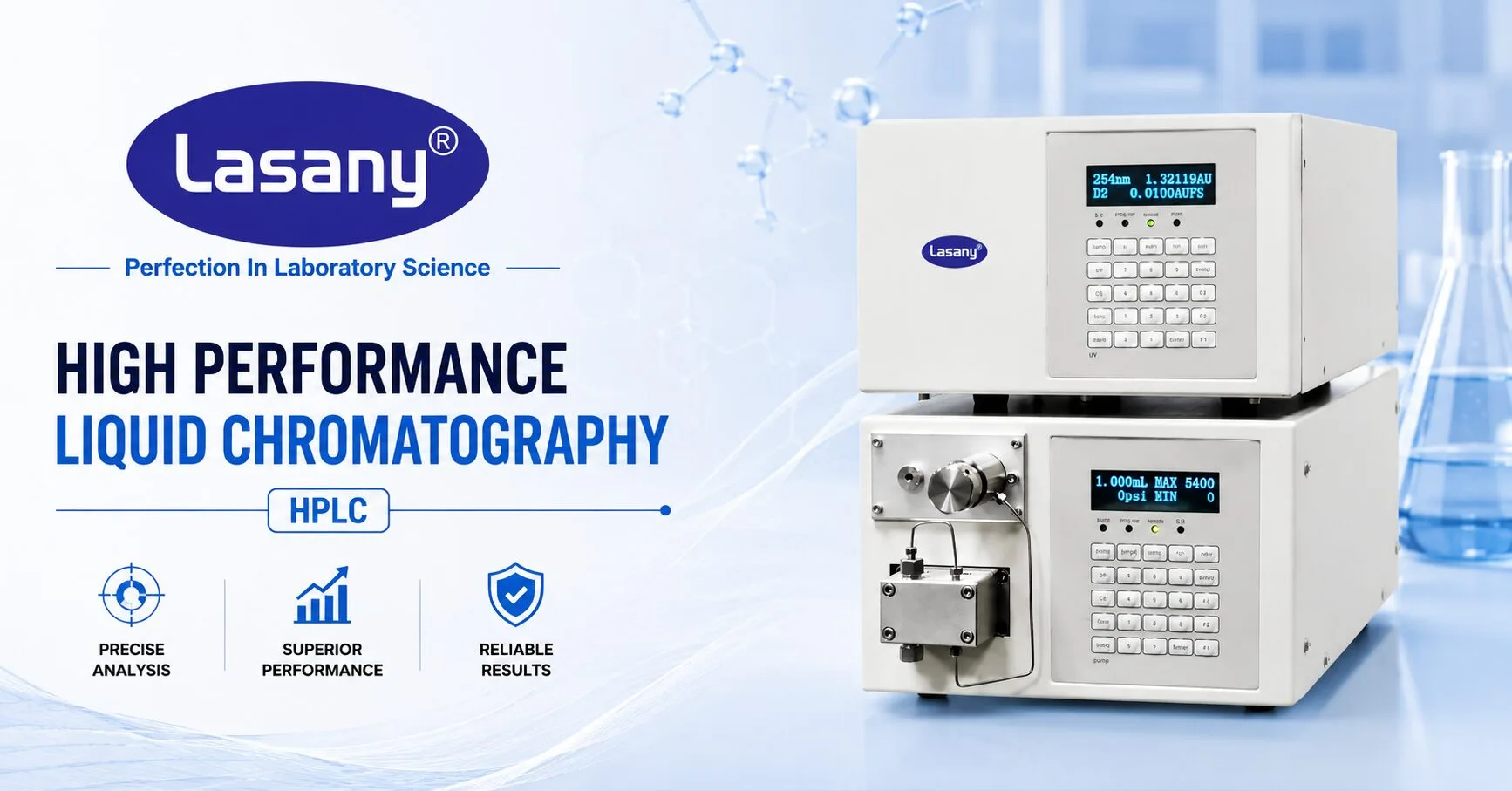
High Performance Liquid Chromatography (HPLC): The Gold Standard in Analytical Separation Science
Modern analytical laboratories face a constant challenge — identifying, separating, and quantifying the complex components found in pharmaceutical formulations, food products, environmental samples, and biological matrices. No single analytical technique has answered this challenge more comprehensively than High Performance Liquid Chromatography HPLC. Combining extraordinary separation power with unmatched sensitivity and reproducibility, HPLC has become the backbone of quality control and research laboratories worldwide.
What makes today’s analytical laboratories truly powerful, however, is not one instrument in isolation—it is the combination of complementary technologies working together. The double beam spectrophotometer, for instance, is routinely used alongside HPLC systems to provide UV-Vis absorbance detection, optical purity confirmation, and method development support. Together, high-performance liquid chromatography and the double-beam spectrophotometer form the analytical foundation of laboratories operating across pharmaceuticals, food science, environmental testing, and advanced chemical research.
In this guide, Lasany International—one of India’s most trusted manufacturers and suppliers of scientific and analytical instruments—explores everything you need to know about High Performance Liquid Chromatography: its working principles, core components, applications, and how it complements instruments like the Double Beam Spectrophotometer in a fully equipped modern laboratory.
What Is High Performance Liquid Chromatography (HPLC)?
High Performance Liquid Chromatography HPLC is a powerful analytical technique used to separate, identify, and quantify the individual components present in a complex liquid mixture. Unlike simple column chromatography, HPLC uses high-pressure pumps to drive the liquid mobile phase through a tightly packed stationary phase column at pressures often exceeding 400 bar—enabling rapid, high-resolution separation of compounds that would be impossible to resolve by any other routine technique.
HPLC operates on the principle of differential interaction—each compound in the sample interacts differently with the stationary phase and mobile phase based on its polarity, size, charge, or affinity. These differences in interaction cause individual components to travel through the column at different rates, arriving at the detector at different times (retention times) — which is how separation is achieved.
The Double Beam Spectrophotometer plays a complementary role in HPLC workflows—used upstream for sample preparation verification, concentration estimation using Beer-Lambert Law, and UV-Vis spectral characterization of compounds before their chromatographic separation. In many pharmaceutical and research laboratories, the double-beam spectrophotometer and HPLC system sit side by side as essential, mutually reinforcing analytical tools.
How Does an HPLC System Work?
Understanding the working principle of high-performance liquid chromatography helps operators optimize method parameters and interpret chromatographic data correctly. Here is the complete HPLC workflow:
Step 1—Mobile Phase Preparation: The analyst prepares the mobile phase—a carefully chosen liquid solvent or solvent mixture (such as water, acetonitrile, or methanol)—that carries the sample through the chromatographic column. Mobile phase composition is critical to achieving selective separation in HPLC.
Step 2—Sample Injection: A precisely measured volume of the prepared sample (typically 1–100 µL) is introduced into the HPLC system through a sample injector—either a manual Rheodyne valve (as found in Lasany’s LI-6210 and LI-6310 models) or an automated autosampler. Just as the double-beam spectrophotometer requires careful sample preparation to avoid matrix interference, HPLC samples must be filtered and prepared accurately before injection.
Step 3 — High-Pressure Pumping: A precision high-pressure isocratic or gradient pump delivers the mobile phase—along with the injected sample—through the chromatographic column at a precisely controlled flow rate and pressure.
Step 4 — Column Separation: The sample passes through the stationary phase column (typically C18, C8, or other bonded silica phases). Each compound in the sample interacts with the stationary phase at a different rate, causing them to separate into distinct bands as they travel through the column—the core of all High Performance Liquid Chromatography analysis.
Step 5—Detection: As separated compounds elute from the column, they pass through a detector—most commonly a UV-Vis detector or photodiode array (PDA) detector that measures absorbance at specific wavelengths. This is where the optical principles underpinning the double-beam spectrophotometer are directly applied—the detector measures how much light each eluting compound absorbs at a characteristic wavelength.
Step 6—Data Analysis: The detector generates a chromatogram—a plot of detector signal versus time—where each peak represents a separated compound. The retention time identifies the compound, and the peak area or height quantifies its concentration. Dedicated HPLC software manages data acquisition, integration, and reporting.
Key Components of an HPLC System
A complete High Performance Liquid Chromatography system integrates several precision-engineered components:
Solvent Delivery System (Pump)
The isocratic or gradient pump is the heart of the HPLC system, delivering the mobile phase at precise flow rates and high pressures. Flow rate accuracy and pressure stability are critical for reproducible chromatographic results in High Performance Liquid Chromatography.
Sample Injector
The sample injector introduces a defined, reproducible volume of sample into the mobile-phase stream. Lasany International’s HPLC models feature Rheodyne injectors (LI-6200, LI-6210, and LI-6310) known for precise injection volume control, minimal carryover, and long operational life.
Chromatographic Column
The column—packed with a stationary phase material (typically 3–10 µm silica particles bonded with C18, C8, or other functional groups)—is where the actual separation occurs. Column selection is the most influential decision in High Performance Liquid Chromatography method development.
UV-Vis Detector
The most widely used HPLC detector. It measures compound absorbance at a selected UV or visible wavelength as compounds elute from the column. The optical detection principles in the HPLC UV detector are fundamentally related to those of the double beam spectrophotometer—both rely on the Beer-Lambert Law to quantify analyte concentration from light absorption data.
Data Acquisition System and Software
Dedicated HPLC software controls the system, acquires detector signals, integrates chromatographic peaks, applies calibration curves, and generates GLP-compliant analytical reports—similar to how the Double Beam Spectrophotometer’s software manages spectral scans and quantitative analysis outputs.
Applications of High Performance Liquid Chromatography
High Performance Liquid Chromatography is one of the most universally applied analytical techniques across science and industry. Here are its most important application areas:
Pharmaceutical Industry
HPLC is the cornerstone of pharmaceutical quality control and drug development. It is used for the assay of active pharmaceutical ingredients (APIs), impurity profiling, dissolution testing, stability studies, and content uniformity testing—all mandated by USP, BP, and ICH guidelines. The Double Beam Spectrophotometer supports pharmaceutical HPLC workflows by providing rapid UV-Vis screening of raw materials and dissolution media before chromatographic analysis.
Food Safety and Nutritional Analysis
Food testing laboratories use High Performance Liquid Chromatography to detect and quantify vitamins, amino acids, preservatives, colorants, mycotoxins, pesticide residues, and adulterants in food and beverage products. Compliance with FSSAI, Codex Alimentarius, and EU food safety regulations depends critically on HPLC data accuracy and reproducibility.
Environmental Testing
Environmental monitoring laboratories apply HPLC to detect organic pollutants, pesticides, herbicides, polycyclic aromatic hydrocarbons (PAHs), and pharmaceutical residues in water, soil, and air samples—where regulatory limits are often in the parts-per-billion range. Many environmental labs also rely on the double-beam spectrophotometer for initial sample screening before HPLC confirmation.
Biochemistry and Life Sciences
In biological research, High Performance Liquid Chromatography is used for protein purification, peptide mapping, amino acid analysis, nucleotide separation, and metabolomics profiling. HPLC is also employed in clinical laboratories for therapeutic drug monitoring and hormone analysis.
Chemical and Polymer Industry
Chemical manufacturers use HPLC for reaction monitoring, purity verification of synthetic compounds, and quality control of polymers, resins, and specialty chemicals.
Cosmetics Industry
Cosmetic testing laboratories use High Performance Liquid Chromatography HPLC to verify formulation composition, detect banned substances, and quantify active ingredients such as UV filters, preservatives, and vitamins in compliance with regulatory requirements.
The Role of the Double Beam Spectrophotometer in HPLC Laboratories
In a fully equipped analytical laboratory, the Double Beam Spectrophotometer and HPLC system are natural partners. The Double Beam Spectrophotometer is typically used for the following:
UV-Vis Spectral Characterization—Determining the maximum absorbance wavelength (λmax) of a compound before setting the HPLC UV detector wavelength for optimal detection sensitivity.
Concentration Estimation—Using the Beer-Lambert Law to estimate sample concentration before HPLC injection, ensuring the injected analyte falls within the linear dynamic range of the chromatographic method.
Method Development Support — The Double Beam Spectrophotometer provides rapid, preliminary absorbance data that guides HPLC method development decisions, including wavelength selection and mobile phase UV cutoff evaluation.
Dissolution Testing — In pharmaceutical dissolution analysis, the Double Beam Spectrophotometer measures drug release in dissolution media—providing a fast, direct measurement that complements formal HPLC quantitation for routine QC.
Raw Material Screening — Before committing an expensive HPLC run, analysts use the Double Beam Spectrophotometer for rapid optical screening of incoming raw materials and reference standards.
This complementary relationship means that laboratories investing in both high-performance liquid chromatography and a double-beam spectrophotometer are better equipped across the full analytical workflow—from initial sample characterization to final quantitative confirmation.
Lasany International: Your Complete Analytical Laboratory Partner
When it comes to sourcing both High Performance Liquid Chromatography systems and Double Beam Spectrophotometers in India, Lasany International offers a uniquely comprehensive product portfolio that serves both needs from a single trusted supplier.
Established in 1998 and headquartered at SCF-132, Sector 17, Panchkula, Haryana, Lasany International is one of India’s most experienced manufacturers, importers, and exporters of scientific, laboratory, and analytical instruments—supplying customers across 97 countries worldwide.
Lasany International’s HPLC Product Range
Lasany International supplies a full range of High Performance Liquid Chromatography systems designed for pharmaceutical, research, environmental, and industrial applications:
LI-6200 — HPLC System with Rheodyne Injector. A reliable, high-performance chromatographic platform for routine and research laboratory applications.
LI-6210 — HPLC System with Rheodyne Injector and advanced pump control for precise isocratic and gradient elution.
LI-6300 — High-Performance Liquid Chromatography system with high-resolution separation capability, rapid analysis speed, and superior reproducibility.
LI-6310 — HPLC with Rheodyne Injector offering enhanced flexibility for complex pharmaceutical, food, and environmental analysis.
All Lasany International HPLC systems feature user-friendly software for system control, data acquisition, chromatogram integration, calibration, and GLP-compliant report generation—making them ready for regulated laboratory environments from day one.
Lasany International’s Double Beam Spectrophotometer Range
Complementing their HPLC portfolio, Lasany International also manufactures a comprehensive lineup of Double Beam spectrophotometers—including models LI-2702, LI-2802R, LI-2900, LI-2904, and LI-3001—covering wavelength ranges from 190 to 1100 nm with touchscreen interfaces, ARM chip control, and full GLP/GMP compliance features.
The combination of a Lasany Double Beam Spectrophotometer and Lasany HPLC system gives laboratories a fully integrated analytical capability—with consistent instrument quality, unified after-sales service, and a single point of contact for all technical support needs.
Why Laboratories Choose Lasany International
Proven Manufacturing Excellence — Over 25 years of instrument manufacturing experience and more than 500,000 units supplied worldwide.
Complete Portfolio — From HPLC and the double-beam spectrophotometer to viscometers, polarimeters, flame photometers, and medical equipment, Lasany International is a one-stop analytical laboratory partner.
Global Export Network — Instruments supplied to customers in Nigeria, Vietnam, Indonesia, Turkey, Brazil, Zimbabwe, Sri Lanka, Iran, Ghana, Colombia, the Philippines, Italy, Uganda, Israel, Kenya, and 97 countries in total.
GLP/GMP Compliance Ready — All instruments meet international quality and regulatory standards, with full after-sales support including installation, training, calibration, and preventive maintenance.
Conclusion: Build a Complete Analytical Laboratory with Lasany International
High Performance Liquid Chromatography HPLC is unquestionably the most powerful routine separation technique available to modern analytical laboratories. Its combination of resolution, sensitivity, speed, and versatility makes it indispensable across pharmaceuticals, food safety, environmental monitoring, biochemistry, and chemical manufacturing.
Yet HPLC does not work in isolation. The Double Beam Spectrophotometer remains an essential companion instrument—supporting method development, sample preparation, raw material screening, and dissolution analysis in laboratories where HPLC is the primary quantitative technique. Together, these instruments define the analytical standard that modern laboratories are built upon.
Lasany International is uniquely positioned to supply both, with a product range spanning High Performance Liquid Chromatography systems and a complete Double Beam Spectrophotometer lineup, backed by over 25 years of manufacturing excellence, global export experience, and dedicated after-sales support.
Get in Touch with Us: –
Panchkula, Haryana
Website: https://lasany.org/
Address: SCF-132, Sector 17, Panchkula, Haryana 134109
Email:- lasanyinternationalindia@gmail.com
Online Support:- 9888911439 / 9803017479
If you are looking for laboratory, analytical, and medical products, then Lasany International is the perfect choice for you.