In today’s industrial and laboratory environments, precise measurement of fluid properties is essential for maintaining product quality and ensuring consistent manufacturing processes. One of the most important instruments used for this purpose is the Digital Viscometer. Industries such as pharmaceuticals, food processing, chemicals, cosmetics, petroleum, paints, and biotechnology rely heavily on viscosity testing to ensure that products meet required standards and performance expectations.
As quality control requirements continue to grow worldwide, the demand for advanced viscosity measurement instruments has increased significantly. It offers reliable, accurate, and repeatable measurements, making it an indispensable tool in modern laboratories and production facilities.
India has emerged as a leading center for scientific instrument manufacturing, supplying laboratory equipment to domestic and international markets. Companies like Lasany International are contributing to this growth by providing advanced laboratory instruments designed to meet the needs of research institutions, educational organizations, and industrial quality control laboratories.
This comprehensive guide explores everything you need to know about digital viscosity measurement systems, including their working principles, applications, benefits, features, maintenance requirements, and factors to consider before purchasing one.
What is a Digital Viscometer?
A Digital Viscometer is a laboratory instrument used to measure the viscosity of liquids and semi-liquid materials. The internal resistance of a fluid to flow is referred to as viscosity. It indicates how thick or thin a liquid is under specific conditions.
For example:
- Water has low viscosity.
- Cooking oil has moderate viscosity.
- Honey has high viscosity.
- Industrial grease has very high viscosity.
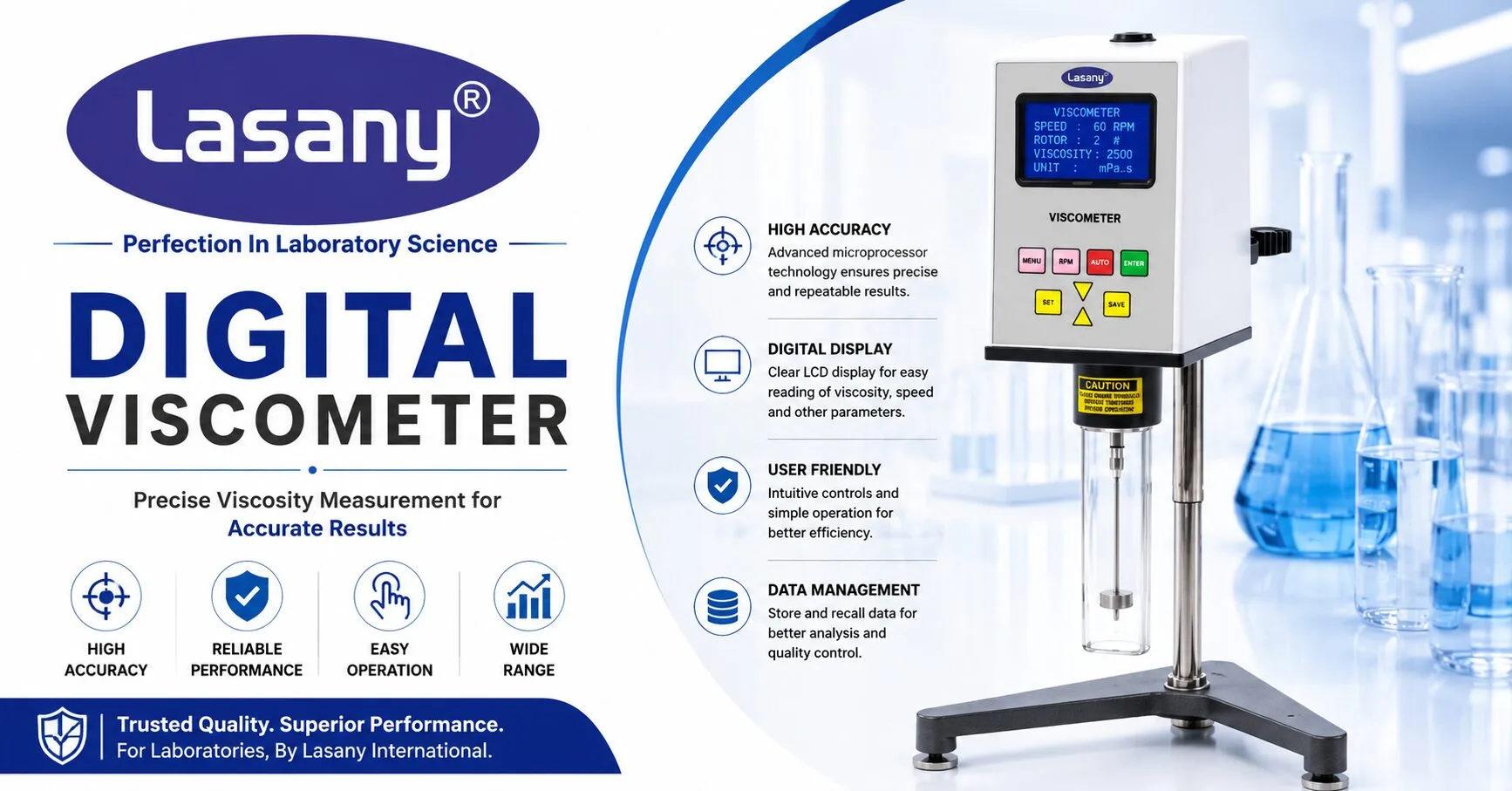
A digital viscosity measurement system uses electronic sensors and microprocessor technology to determine viscosity accurately and display the results on a digital screen.
Unlike traditional analog instruments, modern digital systems provide the following:
- Higher accuracy
- Faster measurements
- Improved repeatability
- Easy operation
- Automatic calculations
- Digital data display
These advantages make them ideal for quality control and research applications.
Importance of Viscosity Measurement
Viscosity is one of the most important physical properties of liquids and semi-solid products.
Accurate viscosity testing helps manufacturers:
- Maintain product consistency
- Improve quality assurance
- Optimize production processes
- Meet regulatory standards
- Enhance product performance
- Reduce manufacturing defects
- Increase customer satisfaction
Without proper viscosity control, products may behave unpredictably during manufacturing, storage, transportation, or final use.
Working Principle of Digital Viscometer
The Digital Viscometer generally operates using the principle of rotational viscosity measurement.
How It Works
- A spindle rotates inside the sample fluid.
- The liquid resists the spindle’s movement.
- The instrument measures the torque generated by this resistance.
- The microprocessor converts torque into viscosity values.
- Results are displayed digitally on the screen.
The relationship between viscosity and shear conditions can be represented as:
η = τ / γ̇
Where:
- η = Viscosity
- τ = Shear Stress
- γ̇ = Shear Rate
This method allows highly accurate viscosity measurement across a wide range of fluids.
Types of Digital Viscometers
Different industries require different viscosity testing solutions.
1. Rotational Digital Viscometer
This is the most commonly used type.
Applications include:
- Paints
- Chemicals
- Pharmaceuticals
- Food products
- Cosmetics
2. Brookfield-Type Viscometer
Widely used in laboratories for research and quality control.
Features include:
- High accuracy
- Multiple spindle options
- Adjustable speeds
- Broad measurement range
3. Portable Viscosity Testing Instrument
Designed for field applications and on-site testing.
Advantages:
- Compact size
- Easy transportation
- Quick measurements
4. High-Temperature Models
Used for:
- Petroleum products
- Lubricants
- Industrial oils
- Bitumen testing
Major Components
A modern Digital Viscometer consists of several important components.
Drive Motor
Provides controlled spindle rotation.
Spindle Assembly
makes immediate contact with the test specimen.
Microprocessor Unit
Calculates viscosity automatically.
Digital Display
Shows:
- Viscosity
- Speed
- Temperature
- Measurement parameters
Control Panel
Allows user interaction and parameter selection.
Temperature Sensor
Some advanced models include integrated temperature monitoring.
Key Features
Modern viscosity testing instruments include several advanced features.
High Measurement Accuracy
Typical accuracy may reach the following:
±1%
Depending on the model and calibration status.
Digital LCD Display
Provides easy-to-read measurements and operating parameters.
Multiple Speed Settings
Allows testing under different shear conditions.
Automatic Calculation
Eliminates manual calculations and reduces errors.
Data Storage Capability
Advanced models support:
- Internal memory
- USB connectivity
- Computer integration
User-Friendly Operation
Simple controls reduce training requirements.
Durable Construction
Industrial-grade materials ensure long service life.
Applications of Digital Viscometer
The Digital Viscometer is used across numerous industries where fluid characteristics are critical.
Pharmaceutical Industry
Pharmaceutical companies use viscosity testing for:
- Syrups
- Creams
- Gels
- Suspensions
- Ointments
Proper viscosity ensures product stability and accurate dosage delivery.
Food and Beverage Industry
Food manufacturers use viscosity analysis for:
- Honey
- Sauces
- Dairy products
- Chocolate
- Syrups
- Beverages
Consistent viscosity improves product quality and consumer satisfaction.
Paint and Coating Industry
Paint producers need exact viscosity control to guarantee the following:
- Uniform coating thickness
- Smooth application
- Proper drying
- Enhanced finish quality
Cosmetic Industry
Cosmetic manufacturers test:
- Lotions
- Shampoos
- Creams
- Hair gels
- Liquid soaps
Viscosity directly impacts product usability and customer experience.
Petroleum Industry
Petroleum laboratories analyze:
- Lubricating oils
- Hydraulic fluids
- Greases
- Fuels
Proper viscosity ensures equipment performance and operational reliability.
Chemical Industry
Chemical processing facilities use viscosity testing for:
- Resins
- Polymers
- Adhesives
- Solvents
This helps maintain product consistency and process efficiency.
Benefits of Using a Digital Viscometer
Modern laboratories benefit significantly from digital viscosity measurement technology.
Improved Accuracy
Electronic measurement reduces human error.
Faster Results
Digital systems provide rapid analysis.
Better Repeatability
Consistent results improve quality control.
Easy Data Interpretation
Digital displays eliminate complex manual calculations.
Increased Productivity
Automation speeds up laboratory workflows.
Reduced Operator Dependency
Results are less influenced by operator skill levels.
Wide Measurement Range
Suitable for low, medium, and high-viscosity materials.
Why Industries Prefer Digital Systems Over Analog Models
Traditional analog viscometers have limitations compared to modern digital instruments.
Digital Advantages
- Automatic calculations
- Better precision
- Faster testing
- Improved repeatability
- Easier operation
- Digital data storage
Analog Limitations
- Manual reading interpretation
- Lower accuracy
- Greater operator dependency
- Limited automation
As a result, most laboratories now prefer digital technology.
Factors to Consider Before Buying
Choosing the right viscosity testing instrument requires careful evaluation.
Measurement Range
Ensure the instrument covers your required viscosity range.
Accuracy Requirements
Higher accuracy is essential for quality-sensitive applications.
Speed Options
Multiple speed settings increase testing flexibility.
Temperature Compatibility
Important for heat-sensitive products.
Spindle Selection
Different spindle designs support different sample types.
Data Management Features
Modern laboratories often require the following:
- USB connectivity
- Computer interfaces
- Data export options
Technical Support
Choose suppliers offering:
- Installation assistance
- Calibration services
- Maintenance support
Calibration Procedures
Calibration is essential for maintaining accuracy.
Basic Calibration Process
- Use certified viscosity standards.
- Select the appropriate spindle.
- Perform measurements.
- Compare results with standard values.
- Adjust calibration settings if necessary.
Regular calibration ensures consistent analytical performance.
Maintenance Tips
Proper maintenance improves instrument lifespan and reliability.
Clean After Every Use
Always clean spindles and accessories thoroughly.
Store Properly
Keep the instrument in a clean and dry environment.
Avoid Mechanical Shock
Handle carefully during transportation and operation.
Perform Routine Calibration
Schedule regular calibration checks.
Monitor Operating Conditions
Avoid excessive humidity and temperature extremes.
Common Problems and Troubleshooting
Unstable Readings
Possible causes:
- Air bubbles
- Improper spindle immersion
- Excessive vibration
Incorrect Results
Possible causes:
- Calibration errors
- Wrong spindle selection
- Poor sample preparation
Motor Performance Issues
Possible causes:
- Electrical fluctuations
- Mechanical obstruction
- Overloading
Routine servicing helps prevent these issues.
Future Trends in Viscosity Measurement Technology
The future of viscosity analysis is becoming increasingly automated and connected.
Emerging technologies include:
- Touchscreen interfaces
- Cloud-based data storage
- Artificial intelligence integration
- Automated sample handling
- Wireless communication
- Smart laboratory connectivity
These innovations will further improve productivity and analytical precision.
Role of Indian Manufacturers in Global Markets
India has become a leading supplier of laboratory equipment due to the following:
- Competitive pricing
- Skilled engineering expertise
- Advanced manufacturing capabilities
- Export-quality production
- Strong technical support
Companies such as Lasany International continue supporting industrial laboratories, educational institutions, and research facilities by supplying reliable analytical instruments that meet international quality expectations.
Why Laboratories Trust Modern Viscosity Testing Solutions
Laboratories worldwide depend on advanced viscosity measurement instruments because they provide the following:
- Reliable performance
- Accurate measurements
- Long operational life
- Reduced maintenance requirements
- Improved productivity
- Better quality control
These benefits make them essential for modern industrial and research applications.
Frequently Asked Questions
What is a Digital Viscometer used for?
It is used to measure the viscosity of liquids and semi-liquid materials for quality control, research, and manufacturing applications.
Which industries use viscosity measurement instruments?
Industries include pharmaceuticals, food processing, cosmetics, chemicals, paints, petroleum, biotechnology, and research laboratories.
Why is viscosity important?
Viscosity affects product consistency, stability, processing efficiency, and final product performance.
How accurate are modern digital systems?
Many instruments provide accuracy levels around ±1%, depending on calibration and operating conditions.
What are the benefits of digital measurement?
Benefits include improved accuracy, faster testing, automatic calculations, better repeatability, and easier operation.
Conclusion
The Digital Viscometer remains one of the most important analytical instruments used across industrial and laboratory environments. Its ability to provide accurate, reliable, and repeatable viscosity measurements helps manufacturers maintain product quality, optimize production processes, and meet regulatory requirements.
From pharmaceutical formulations and food products to petroleum oils and cosmetic formulations, viscosity testing plays a crucial role in ensuring consistent product performance. As technology continues advancing, modern digital instruments offer improved automation, enhanced accuracy, and better data management capabilities.
Organizations seeking dependable laboratory solutions often rely on trusted manufacturers and suppliers such as Lasany International, which continue contributing to scientific innovation through high-quality analytical equipment. Investing in a reliable viscosity measurement system ensures long-term operational efficiency, improved quality control, and superior laboratory performance.
Get in Touch with Us: –
Panchkula, Haryana
Website :- https://lasany.org/
Address :- SCF-132, Sector 17, Panchkula, Haryana 134109
Email :- lasanyinternationalindia@gmail.com
Online Support :- 9888911439 / 9803017479
If you are looking for Laboratory, Analytical, and Medical Products, then Lasany International is the perfect choice for you.