
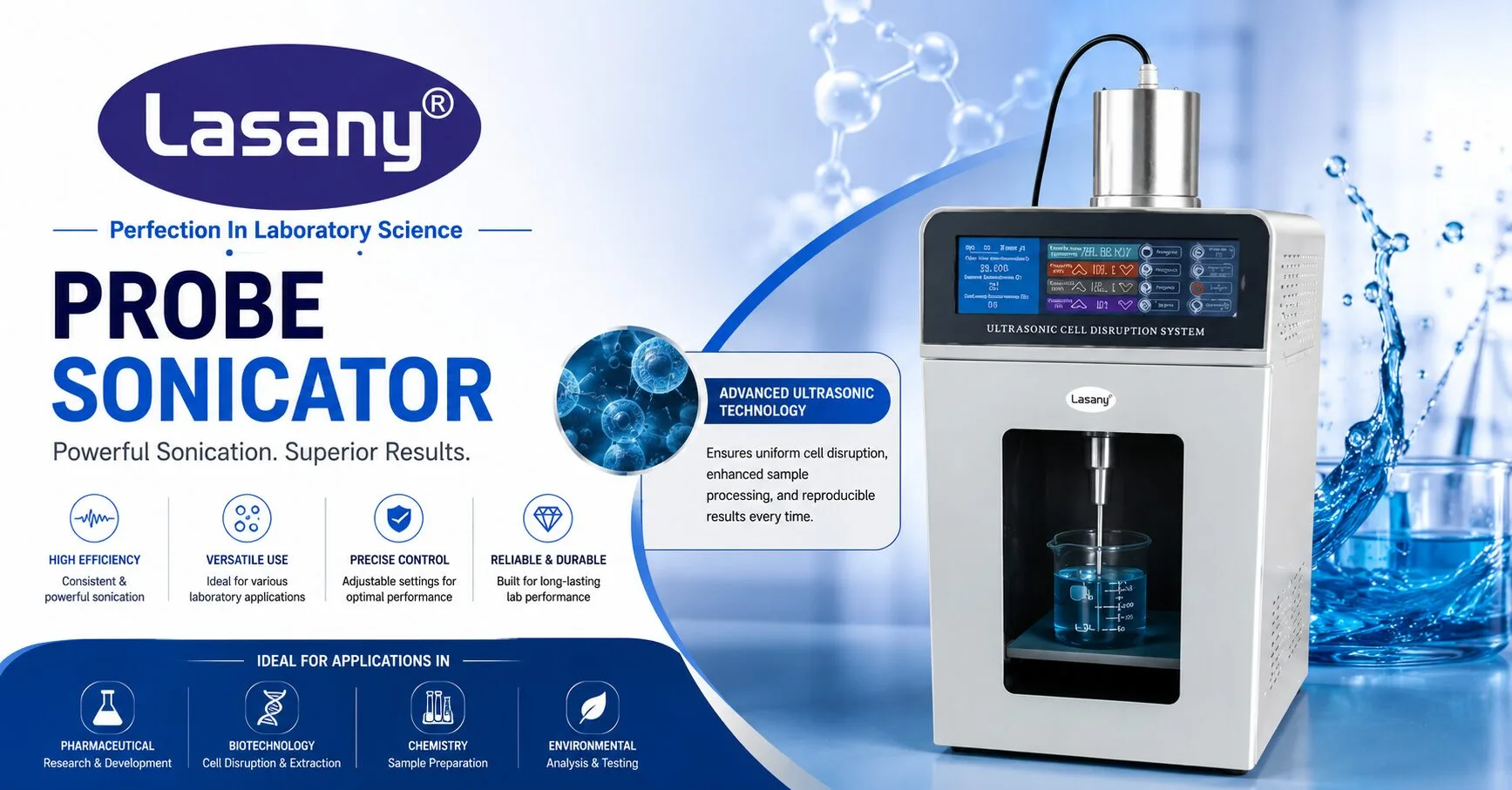
Probe Sonicator : The Ultimate Guide to Ultrasonic Homogenization Technology
If you work in a laboratory, research facility, pharmaceutical unit, or industrial processing plant, chances are you’ve encountered the need to break down particles, emulsify compounds, or extract bioactive substances from complex matrices. At the heart of these processes lies one indispensable instrument—the Probe Sonicator. This guide walks you through everything you need to know, from their working principles to their applications, and why brands like Lasany International are setting new benchmarks in ultrasonic technology.
What Is a Probe Sonicator?
A probe sonicator, also known as an ultrasonic homogenizer or ultrasonic liquid processor, is a scientific instrument that uses high-frequency sound waves—typically in the range of 20 kHz to 40 kHz—to disrupt particles, cells, or molecules in a liquid medium. Unlike bath sonicators, which transmit ultrasonic energy indirectly through a water bath, it delivers energy directly into the sample through a metallic probe (also called a horn or tip). This direct contact mechanism results in far greater energy transfer, making it significantly more efficient for demanding laboratory and industrial tasks.
The basic working principle involves a piezoelectric transducer converting electrical energy into mechanical vibrations. These vibrations are amplified through the probe and create rapid pressure fluctuations in the liquid, generating a phenomenon known as acoustic cavitation. The violent collapse of microscopic bubbles during cavitation produces localized energy bursts capable of breaking chemical bonds, rupturing cell walls, and reducing particle sizes to the nanometer scale.
Key Components of a Probe Sonicator
Understanding the anatomy of a probe sonicator helps you make better purchasing and operational decisions:
- Transducer: Converts electrical signals into ultrasonic vibrations using piezoelectric crystals.
- Booster: Amplifies or reduces the amplitude of vibrations before they reach the probe.
- Probe (Horn/Tip): The metallic element that contacts the sample directly. Available in various diameters — microtips for small volumes and large-diameter probes for bulk processing.
- Generator (Power Supply): Controls the frequency, amplitude, and output power of the system.
- Cooling Jacket/Chamber: Many setups include temperature-controlled chambers to prevent sample overheating during prolonged sonication.
Premium brands like Lasany International engineer these components with precision-grade titanium probes and smart digital generators that allow researchers to fine-tune parameters for reproducible results.
Types of Probe Sonicators
Not all probe sonicators are created equal. Depending on your application, volume requirements, and budget, you can choose from:
1. Handheld / Benchtop Probe Sonicators
These are the most commonly used lab instruments. A benchtop probe sonicator is ideal for sample volumes ranging from 1 mL to 500 mL. They are compact, easy to operate, and suitable for general laboratory use including cell lysis, nanoparticle synthesis, and emulsion preparation.
2. Ultrasonic Flow Cell Sonicators
Designed for continuous processing, these systems pump liquid through a flow cell fitted around the probe. Flow-through probe sonicators are ideal for pilot-scale and industrial applications where large volumes must be processed uniformly.
3. Cup Horn Sonicators
A hybrid between bath and probe sonicators, cup horn systems allow closed-container sonication. They are often used for samples requiring sterility or when direct probe contact may contaminate the sample.
4. High-Power Industrial Probe Sonicators
For heavy-duty industrial applications—such as biodiesel production, sludge treatment, or large-batch nanoemulsion preparation—high-power probe sonicators with outputs exceeding 1000W are available. Lasany International manufactures robust industrial-grade probe sonicators engineered for continuous duty cycles and long operational life.
Applications of Probe Sonicators
The versatility of the probe sonicator makes it an invaluable tool across multiple industries:
Biotechnology and Life Sciences
Cell lysis is one of the most widespread uses of a probe sonicator. Disrupting bacterial, yeast, or mammalian cells to extract intracellular proteins, enzymes, and DNA requires precise and reproducible sonication. Probe sonicators provide the intensity needed to lyse even the most robust cell walls without excessive thermal damage when used with pulse mode and cooling.
Pharmaceutical Industry
Drug formulation scientists rely on the probe sonicator to prepare nanoemulsions, liposomes, and solid lipid nanoparticles. The ability to reduce droplet size to below 200 nm is critical for improving bioavailability and drug delivery efficiency. Consistent particle size distribution—achieved through calibrated probe sonicators—ensures batch-to-batch reproducibility in pharmaceutical manufacturing.
Nanotechnology and Material Science
Preparing stable nano-dispersions of carbon nanotubes, graphene, metal oxides, and quantum dots demands high-intensity sonication. The probe sonicator effectively deagglomerates nanoparticles and ensures uniform dispersion in polymer matrices, solvents, or aqueous media—a key step in developing advanced functional materials.
Food Technology
In the food and beverage industry, probe sonicators are used to homogenize dairy products, create stable oil-in-water emulsions, extract bioactive compounds from plant materials, and inactivate pathogens without the need for thermal processing. Ultrasonic extraction using a probe sonicator can recover polyphenols, flavonoids, and essential oils from herbs with significantly higher yields than conventional methods.
Environmental Science
Probe sonicators play a role in wastewater treatment by breaking down sludge, enhancing the biodegradability of organic pollutants, and aiding in the extraction of contaminants from soil and water samples for analytical testing.
Chemistry and Sonochemistry
Accelerating chemical reactions, promoting polymerization, and facilitating electrochemical processes are all achievable through sonochemistry—the science of using ultrasound to drive chemical reactions—made practical with a high-performance probe sonicator.
How to Choose the Right Probe Sonicator
With so many options on the market, selecting the right probe sonicator requires careful consideration of the following parameters:
1. Power Output (Watts): Higher wattage provides more cavitation energy. For small volumes (< 10 mL), 50–150W is sufficient. For volumes up to 1 liter or more, 500W–1000W systems are preferable.
2. Frequency: Most probe sonicators operate at 20 kHz, which generates powerful cavitation ideal for particle disruption. Some specialized models operate at higher frequencies (40 kHz) for gentler processing.
3. Amplitude Control: Look for models offering variable amplitude (typically 20%–100%) and pulse mode settings. These features are essential for delicate biological samples.
4. Probe Material and Size: Titanium alloy probes offer durability and chemical resistance. Choose probe diameter based on your sample volume—smaller probes for micro-volumes, larger ones for bulk processing.
5. Digital Display and Data Logging: Modern probe sonicators from quality manufacturers like Lasany International come with digital control panels, LCD displays, real-time energy monitoring, and data-logging capabilities for documentation and regulatory compliance.
6. After-Sales Support and Warranty: Reliable after-sales service, easy availability of spare probes, and comprehensive warranties are critical, especially for high-frequency laboratory environments.
Why Lasany International Stands Out
When it comes to ultrasonic technology in South Asia and beyond, Lasany International has built a reputation for delivering high-performance scientific instruments that combine precision engineering with affordability. Their probe sonicator lineup caters to a broad spectrum of users—from academic research labs to large-scale industrial processors.
Lasany International’s probe sonicator is designed with
- Titanium-grade probes for extended service life and corrosion resistance
- Microprocessor-based digital controllers for precise amplitude and time settings
- Pulse mode functionality to minimize heat generation in sensitive samples
- Compact ergonomic design suitable for limited bench space
- Compliance with international quality standards, ensuring reliability in regulated industries
Beyond the product itself, Lasany International provides expert technical support, prompt spare parts availability, and instrument calibration services—making them a trusted partner for laboratories that depend on consistent, reproducible results.
Best Practices for Using a Probe Sonicator
To maximize the performance of your probe sonicator and extend its operational life, follow these best practices:
- Position the probe correctly: Immerse the probe tip at least 1 cm below the liquid surface and away from the walls of the container to prevent standing waves and cavitation erosion of the vessel.
- Use pulse mode for biological samples: Continuous sonication generates heat. Alternate on/off cycles (e.g., 5 seconds on, 5 seconds off) protect thermolabile proteins and nucleic acids.
- Work in an ice bath: Keep samples on ice during sonication to prevent thermal denaturation.
- Inspect the probe regularly: Pitting or erosion on the probe tip reduces efficiency. Replace worn probes promptly.
- Calibrate periodically: Use calorimetric methods to verify that your probe sonicator is delivering the expected energy output.
Conclusion
The Probe Sonicator is far more than a simple laboratory tool—it is a precision instrument that sits at the intersection of physics, biology, chemistry, and engineering. Whether you’re breaking cells, formulating nanoparticles, or extracting bioactive compounds, the right probe sonicator can dramatically enhance your process efficiency, yield, and reproducibility.
Investing in a reliable, well-engineered probe sonicator from a trusted manufacturer like Lasany International ensures that your laboratory or production facility benefits from cutting-edge ultrasonic technology backed by expert support. As research demands continue to evolve, the probe sonicator will remain an indispensable pillar of modern scientific and industrial processing—and choosing the right one today sets the foundation for breakthrough results tomorrow.
Get in Touch with Us: –
Panchkula, Haryana
Website :- https://lasany.org/
Address :- SCF-132, Sector 17, Panchkula, Haryana 134109
Email :- lasanyinternationalindia@gmail.com
Online Support :- 9888911439 / 9803017479
If you are looking for Laboratory, Analytical, and Medical Products, then Lasany International is the perfect choice for you.